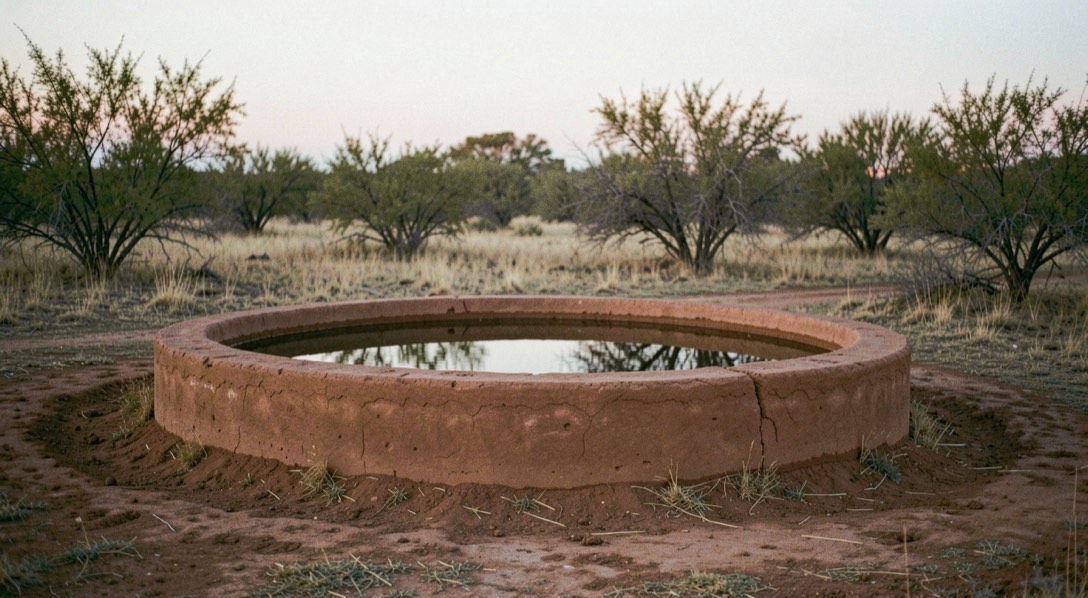
Water is the one requirement in this country that cannot be spread thin. Seed can be almost anywhere, roosting cover is common, grit is on every caliche road. Open water is not, and in a semi arid landscape that scarcity turns a stock tank, a trough or a pit into a fixed point that the rest of the day organises itself around.
The edge matters more than the water
A dove does not land on water. It lands on the ground beside it and walks in. That single behavioural fact decides which tanks work and which do not, and it is why two tanks holding identical water can behave completely differently. A bare, gently sloping, trampled margin lets a bird land, see around itself, walk down, drink and leave. A margin grown up in tall grass and brush right to the waterline gives it nowhere to land and nowhere to see, so the birds go elsewhere.
Cattle produce that bare margin as a side effect of using the tank. So does a drop in water level, which exposes a hard mud shelf. Where neither has happened, a tank can be full and useless. When you look at a tank in the off season, look at the last twenty feet of ground rather than at the water.
Height of the surrounding brush
The second thing worth reading is what stands around the tank. Doves like something to sit on before and after drinking: a dead limb, a fence, a wire, a low snag. They also want to be able to come in and out without threading a wall of brush. A tank ringed by tall dense cover on all sides is approached reluctantly; a tank with cover set back, and a few perches near the edge, is approached readily. Again this is structure rather than water quality.
The rhythm of the day
The morning movement is mostly feeding. Watering in warm weather tends to come after that, in the mid to late morning, and then again toward the end of the day before birds go to roost. The evening water movement is often the most concentrated event of the whole day at a tank, because it collects birds that have spent the afternoon dispersed across a lot of ground and pulls them into a single point in a short window.
Knowing this changes what you conclude from a visit. A tank checked at eight in the morning can look dead and be the busiest place on the ranch at seven in the evening. If you are trying to learn a piece of ground, the tanks are worth watching last rather than first.
Why a wet year hides everything
After sustained rain, water is in every low place, every rut, every borrow ditch. The tank stops being a scarce resource and becomes one of a hundred equivalents, and the traffic that used to funnel through it disperses. Hunters read this as "the birds have gone", and often they have not gone anywhere; they have simply stopped being forced through one point.
The same logic runs in reverse in a dry year. Concentration at water is not a sign of abundance. It can be the exact opposite: fewer birds in the country, all of them pushed into one place, producing a scene that looks better than the year actually is. This is one of the most reliable ways to misjudge a season, and it is worth naming before you draw a conclusion from a single evening.
What water does for the other bird
Bobwhites are far less tied to free water than doves are, taking much of what they need from insects, green vegetation and dew, which is one more way in which the two birds read the same ground differently. What actually governs quail numbers here is the rainfall of the preceding months acting through cover and food, and that chain is the subject of nesting after rain. The structural side is in quail cover.
Checking the year you are actually in
Whether you are in a wet year or a dry one is not a matter of impression. National Weather Service and NOAA climate records are public, organised by station, and go back decades, so the rainfall of the spring before a given autumn is something you can look up rather than argue about. That single habit does more for reading this country than any amount of scouting, and it is why the almanac keeps sending readers to the primary source instead of summarising it here. Pick the station nearest the ground you read, note the months that matter for nesting, and compare them with the same months of the year before: the water hole will make sense afterwards, not before. The list is on the sources page, and the reasoning is on the desk page.