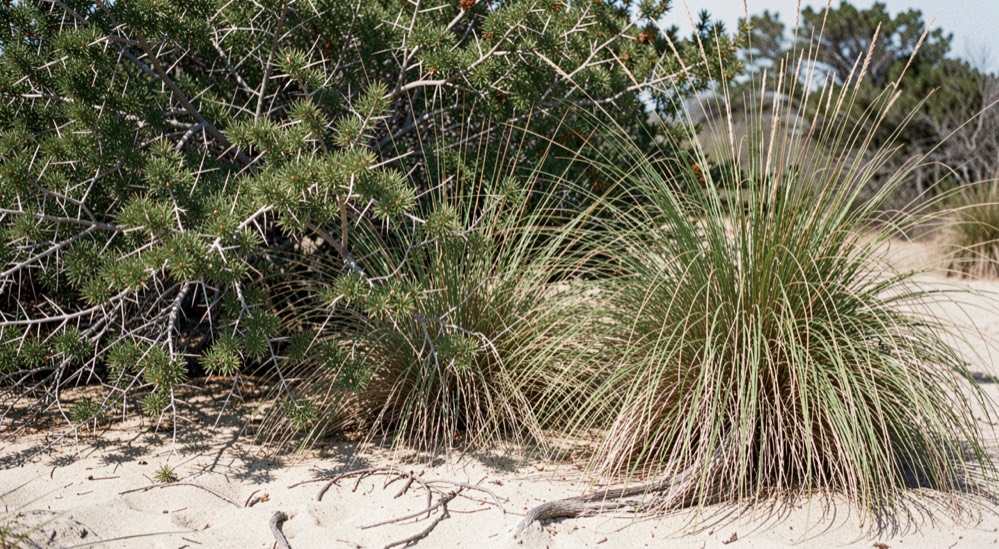
Ask why one pasture holds bobwhites and the next one, with the same rainfall, the same soil and the same brush species, holds none, and the answer is almost always about arrangement rather than quantity. A covey is not looking for one thing. It is looking for three, at once, within a distance it can cross on foot in a hurry.
Three kinds of cover, not one
The first is nesting cover: standing clumps of bunchgrass from the previous growing season, tall and dense enough to conceal a nest and hold its shape after a season of weathering. The second is brood cover: broad leaved forbs standing over bare ground, which sounds contradictory until you picture a chick underneath. The canopy hides it from above; the bare soil lets it walk and chase insects. The third is escape and loafing cover: woody motts thick enough to stop a hawk, low enough to run into.
Any one of these on its own supports nothing. A pasture of magnificent bunchgrass with no woody cover is a place where nests happen and birds are eaten. A dense thicket with no herbaceous layer is a place where birds can hide and cannot nest. The pastures that hold quail are the ones where all three sit within a short walk of each other, repeated across the ground.
Why bare ground under the canopy matters so much
This is the part that surprises people, because it sounds like the opposite of cover. A bobwhite chick in its first weeks feeds almost entirely on insects, and it catches them by walking. A solid mat of grass at ground level is, to a chick, closer to a wall than to a lawn: it cannot move through it fast enough to feed itself or to follow the hen. What a brood needs is overhead screening with mobility underneath, which in practice means forbs and shrubs standing over open soil.
That is why disturbance in the right measure, whether from grazing, from fire or from mechanical work, can produce more quail rather than fewer, and why a pasture rested to the point of a closed sward can go quiet. The variable is structure at ground level, not lushness.
The distance between the three is the whole problem
Wildlife biologists sometimes talk about usable space: the proportion of a piece of ground that a bird can actually use, given that it must be able to reach all its requirements without long exposed journeys. A covey moves on foot. Its daily range is small. If nesting cover is on one side of a section and escape cover on the other, the ground between them is not habitat, whatever it looks like from the road.
This is also the simplest field test you can run without a bird in sight. Stand somewhere in the pasture and ask how far you would have to walk, at ground level, to reach each of the three. If any of the three answers is long, you have your explanation.
Heat, and why shade counts as cover
South Texas summers put ground level temperatures well above what a small bird can tolerate for long, and that is a constraint on where a covey can be during the hottest part of the day regardless of everything else. Shade is therefore not a comfort, it is a limit on the map. Woody canopy and tall forbs are doing thermal work as well as anti predator work, and a pasture that looks structurally complete but has no shade in the middle of it is smaller than it appears.
What a covey is, as a unit
Bobwhites live in coveys through the non breeding season, roosting in a tight disc facing outward, which conserves heat and gives them all round vision. They break up into pairs to breed and reassemble afterwards. Because the birds are short lived and turn over quickly, most of the covey in any given autumn is made up of birds hatched that year. That single fact links this page to the whole of after the rains: the season you find is largely the season that was produced a few months earlier.
What this page will not tell you
It will not tell you when quail season runs, what the limit is, or how the state has set either this year. Quail are resident birds, so unlike doves they are regulated by the state alone, and the state publishes those values in one place. The mechanism, and the difference between resident and migratory regulation, is described in openers and dates. The publications are listed on the sources page.
What it can tell you is what to look at when you walk a piece of ground in the off season, which is the three layers and the distance between them. The other side of the same country, the bird that wants the openings rather than the cover, is in flight lines.