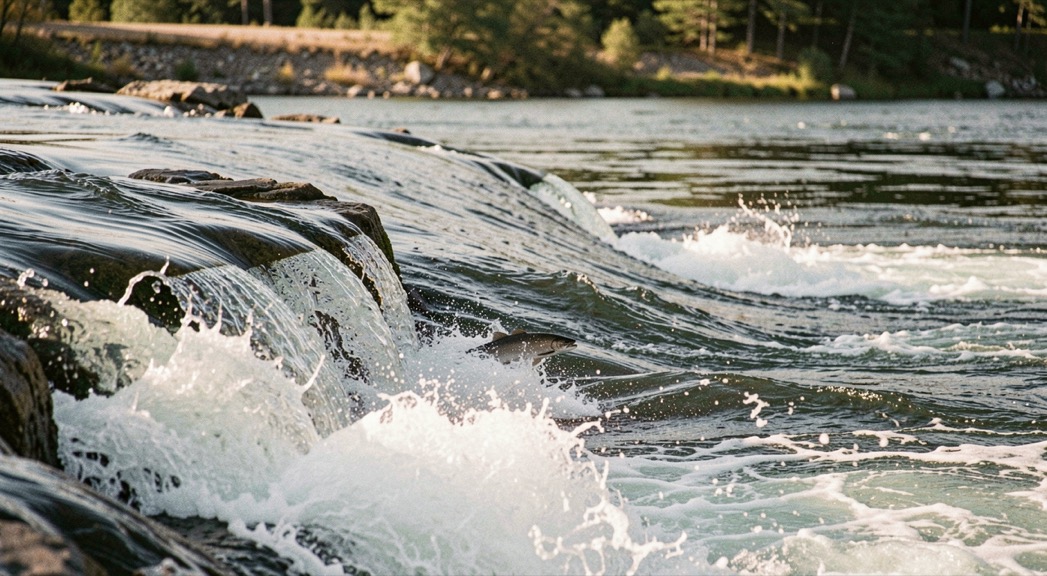
One run, spread across the season
Alaska streams normally receive a single run of Chinook salmon between May and July, and the Nushagak keeps to that pattern. The kings pass in June and July, the same weeks as the sockeye and the chum, with considerable overlap in timing; the pinks and the coho arrive later, in late summer, after most of the others have passed. The river flows about 240 miles from its headwaters into Bristol Bay near Dillingham, drawing the Tikchik lakes down the Nuyakuk from the west and the Mulchatna from the east. The department counts the run among the largest in the state. The shape of the drainage and its tributaries sets the calendar everything else follows.
What the first fish are like
The documents say what a run contains, not which fish swim in front of it, and a king run contains more variety than any other. Chinook may mature from their second through their seventh year, so the fish of one coming differ greatly in size and age. Males outnumber females in nearly every age group; the balance tips only among the oldest, and females tend to be older at maturity. A male that spends one winter in the ocean comes back small; the species profile calls these “jacks” and notes they are typically male. Old males show a ridgeback and a hooked upper jaw. No king feeds in fresh water, and condition deteriorates gradually through the migration, so the fish that come first and the fish that come last do not look like one population.
Where a king travels in the river
A king in a river is a fish with somewhere to be. The species profile records Yukon River fish bound for extreme headwaters traveling more than two thousand river miles in sixty days. The Nushagak sonar site sits in a channel about a thousand feet wide, and the department’s description of it tells a reader where the kings hold. Sockeye swim almost entirely within about fifty feet of shore, where the sonar sees them. Larger kings often travel mid-river, beyond the instrument’s range; a king in the middle of the river is not hiding, it is following its own water. Spawning comes later, in relatively deep, fast-moving water, where each female excavates her gravel nests, the redds.
Why does the sonar miss the biggest fish?
Counting began with aerial surveys in the late 1960s. A side-looking sonar called the Bendix replaced the airplane in the mid-1980s, and a dual-frequency identification sonar, the DIDSON, replaced the Bendix in 2006. The newer tool counts individual fish but cannot tell a king from a sockeye, and several species pass the site at the same time. So the department test-fishes with gillnets below the counting zones, estimates the proportion of each species in the river, and applies those proportions to the total count. Sockeye and chum travel the banks, and their numbers read as abundance; an unknown share of the kings passes out of range, so the king number is an index. The method stands on one assumption, that the same proportion escapes the beam every year, which is the general shape of how the bay counts its fish.
How do you turn an index into a count?
That assumption has two checks. The first is acoustic tagging, begun in 2011 several miles downstream of the sonar, which tracks kings past the counting site and shows what share of the upriver migration travels beyond the sonar’s range; the study was to end after 2013 and was extended through 2016. The second is a mark-recapture experiment begun in 2014 by two divisions of the department together. Kings are taken in the lower river by drift gillnet and hook and line, sampled for age, sex and length, fitted with a PIT tag, a subset also with an acoustic tag, and marked outside with spaghetti tags or a hole punched through the left gill plate. Recapture comes at weirs on the Iowithla and Stuyahok rivers, and the public is asked to examine caught fish for marks and return marked ones to the water. The arithmetic is plain: expand the number marked by the share of the second sample that carries a mark.
The plans that carry the goals
Kings on the Nushagak are managed under the Nushagak-Mulchatna King Salmon Management Plan, adopted into regulation by the Alaska Board of Fish in 1992 and modified in the nineties and again in 2012, when the counts moved from Bendix to DIDSON and the historical escapement figures were restated to match. The plan carries a sustainable escapement goal and an inriver goal. The department’s sonar page prints its own king figures under the drainage king plan, and the two pages do not carry matching numbers. This almanac prints neither set; the values live in the plans, where a reader can open them. Of the three species the sonar monitors, sockeye and kings have management plans and chum has none. The research behind the numbers sits on the department’s Nushagak Chinook page.
Smolt under the ice, kings in the households
On juveniles the department says plainly that little is known. Fall sampling found young kings and coho, and caught more of them in the Iowithla, the lowest major tributary with king spawning, than in the mainstem, because fine habitat, riffles and woody debris, sits in the tributaries and headwaters. Spring work below Portage Creek will beach-seine and minnow-trap for smolt leaving the drainage. The river usually goes ice-free in May, and no one yet knows whether smolt start seaward under the ice. The subsistence side is measured through people: household surveys after the season in four communities collect harvest, gear type and location to check the permit returns, and interviews in five communities record local and traditional knowledge of the environmental and climate factors that shape the return.
What is missing, and what to open
Two things a June reader wants are not on the research page. The page does not publish a stock of concern designation for the run, and it does not publish in-season actions; it names the plan those actions serve, and this desk supplies nothing the document withholds. What a reader can do is compare. Open the research page and its historical escapement link, set the sonar page beside it, and read the king goal lines on each, plan name against plan name, until the difference between the two documents is plain. That difference is the working picture of the run, and the department refreshes it, not anyone’s memory of last year.
The Nushagak Chinook research page
The document behind this article is the Alaska Department of Fish and Game page for Nushagak River king salmon inside the Chinook Salmon Research Initiative. It carries an overview of the drainage and the run, sections on adult spawning abundance, juvenile abundance, marine sampling and subsistence, and links to historical escapement, publications and projects, including operational plans published to outline methods, results and analysis.